The jeepney ride from Sibulan was typical. Crowded full of local Negros folks, and me a tall out of place foreigner. I was soon put at ease. several passengers helped me with my luggage, and with the info on the proper fare to pay. As we approached Dumaguete, I strained to look out the narrow side windows of the van. I could see very little as we jostled along the National highway, but did notice the diminutive and round faces I came to associate with provincial people. We passed several schools, universities among them, and it seemed Dumaguete was indeed a college town, bustling with students, motorcycles, and tricycles.
I had called ahead to the Bethel guest house, but they had no available rooms. They did recommend an alternative, the OK pension... As I had no idea where to go I asked a fellow jeepney passenger, and they were very polite and helpful, directing the driver in visayan to the pension house. Dumped in front of the hotel with my three bags, I sighed in relief that the long days trip was now over. It was just a matter of checking in, and flopping on a bed in an air conditioned room to relax for a while. I had arrived in Dumaguete, not quite knowing why I was here or what I was going to do. In any event it was a fateful and profound step in my quest to assimilate into the Philippine culture, as much as a foreigner could.
The OK Pension proved in fact, not to be so OK, so after two nights of cats fighting in the open courtyard just outside my room, I transferred to the Honeycomb guest house on Rizal Boulevard. I negotiated a rate for a ten day stay not knowing if I would remain after that or move on. The Honeycomb is an old Spanish style mansion dating to the beginning of the twentieth Century. Converted to a hotel, it was charming but somewhat rundown from lack of routine maintenance, never the less a nice place with friendly young girls at the front desk.
There I was smack dab in the middle of expat central, not knowing this at first, I quickly became aware of the charms and pitfalls of the so called "Boulevard", as it is known locally...
Friday, October 17, 2008
Discovering Dumaguete 2


Tuesday, October 14, 2008
Discovering Dumaguete
The first time I heard the name Dumaguete, I was sitting at a seaside cafe in Moal Boal. A divers resort, Moal Boal and nearby Panagsama Beach lie on the south western coast of Cebu Province.
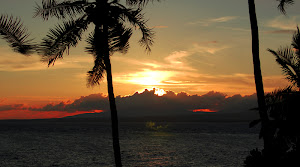
As I dreamily contemplated the looming mist shrouded mountains of Negros Oriental, I ask a waitress what that place was over there, pointing across the Tanon Straight. She replied "That's Negros, and it's my place." I asked her what it was like over there. She replied, "It is very green, many farms and fruit plantations sir." I said "ahh, a nice place?" "yes" she replied, "friendly people and a quiet clean place." Sitting there it looked primordal in the hazy orange sunset of early evening. What town is over there I wondered, what kind of people inhabit that place of large dormant volcanoes and verdant forests? Further conversation yielded the name Dumaguete as the principle municipality in southern Negros Oriental.
I stayed two more weeks at Panagsama beach. I enjoyed the white sand beaches, the nightlife, and touring around on a rented motorcycle. I kept wondering about Negros, it was getting the best of my curiosity. I canceled plans to return to Cebu city and bought a bus ticket to Bato, where I could catch a ferry to Sibulan, just north of Dumaguete. It happened that fast, an impulse to visit a seemingly enchanted place of waiting adventures and discovery. It was a trip that changed my life in so many ways. What follows here is a retrospective of my personal discovery, my journey to Negros, a journey to myself, and a journey to understand the Philippines and it's people.
Thursday, August 14, 2008
Who is Visiting Dumaguete?
I pulled this interesting statistic from a local news article. It shows quite clearly the trend in tourism and visitors to Dumaguete. A 13% increase in visitors from other countries with Koreans leading 3:1 over Americans, the next highest number of foreign nationals.
"Negros Oriental Alien Control Officer Peter Bueno disclosed that his office collected P13,826,110 (US$307,797) in 2007, almost 14 per cent higher than the 2006 collection of P11,915,029.65.
Bueno said the bulk of the fees collected was from tourists who visited the province last year.
Records show that in 2007, almost 1,000 tourists had visited Negros Oriental, with Koreans topping the list at 330, followed by Americans, 105, British, 46, and Germans, 25, and Japanese, 22.
The Bureau of Immigration is an attached agency of the Department of Justice and collects fees from foreign students, tourists and aliens taking up temporary or permanent residence here."
Saturday, August 2, 2008
Dumaguete to Cebu City by Motorcycle
I often go to Cebu City for various reasons. Sometimes a visa run, other times shopping or other business. This time tired of riding ferries or Ceres Liners, I decided to ride my motorcycle. I figured I could shave at least a half hour from the trip if I got lucky with the ferry connection to Bato from Tampi.
I actually left from Siaton not Dumaguete, so my trip was lengthened by 40 minutes. I made it from Siaton to Tampi in just over one hour, a rather fast time as it was Sunday and the traffic was light. As I approached the dock at Tampi the barge was loaded and just about to leave, the dockmen waived me on and I scooted onto the ship as they raised the ramp. Timing is everything, and in this case I was very lucky.
Disembarking at Bato after a thirty minute ride on the ferry, I sorted out my things and took off for Cebu City. On a Sunday, as I mentioned before, the traffic is very light making the first two thirds of the trip relaxing and very enjoyable. The road winds around through Oslob, Argao, and Dalaguete. A motorcyclist's dream of switchbacks, chicanes, and sweeping turns are an adventure and joy to ride. Just be very careful of the Ceres liners that also ply this road in abundance.
The coastal road has a decidedly Mediterranean feel (except for the flora), and the resorts and large homes carved into the seaside cliffs add to the ambiance. It is a beautiful ride, and very different from riding on the bus.
After getting to Car Car, the traffic increases exponentially. Not as relaxing, driving speed is still about 60-80 KPH, but you are surrounded by other motorists. A careful eye and dilligence is required. The fun goes out of the trip by the time you reach the outskirts of Cebu, but it is not so bad that anyone could not handle it.
In the end, my trip from Bato to Mactan Island Island took under three hours. I did in fact shave off a 1/2 hour to the south terminal where the bus normally would stop. A nice ride on a Sunday mid morning, and even on my 150cc underpowered steed, very doable.
Monday, July 7, 2008
Visiting Siaton
Since family ties are so important here in the Philippines, we have occasion to visit Siaton somewhat frequently. Siaton is a very small town at the tip of Oriental Negros. Traveling south from Dumaguete, it is about a hours drive if you go slowly. If you are a dare devil motorcycle rider(I am not) the trip can be done in 40 minutes.
The first thing that strikes you about Siaton are the bountiful and verdant rice plantations as you enter town. Fed and irrigated by two rivers, Siaton is an agricultural center in the region. In that way Siaton is more or less the main market town for Southern Negros Oriental. Much of it's bounty heads north to Dumaguete for distribution there. Truckloads of fish, rice, and produce find there way north to the larger markets.
Siaton is a quiet villiage, with only a few modern bussinesses. There is a wet market, town square, and a satellite campus of NORSU University. A sleepy town, with mostly bicycle pedicabs, Siaton has a quite charm of its' own. If you are an expat you will be looked at with curiousity although nearby Tambobo Bay supplies a limited flow of forein visitors to town. English is no as freely spoken as in Dumaguete, but as this is still largely a province town, that is not surprising.
The beaches of Siaton are expansive and consist mostly of brown sand, normally almost deserted as far as recreational use is concerned. You will find mostly native houses and fishing boats along the shore line. I had the occasion to spend a day at the families beach cabana a few days ago. the pictures show the way the Philippines was everywhere only a few years ago. It was a pleasant change fom the crowded beaches surrounding Dumaguete. Sitting there having a beer and eating barbecue, it was not hard for me to imagine being in the Philippines of 100 years ago.
Siaton, a worthwhile stop if you are traveling to Lake Balanan just south of town.